
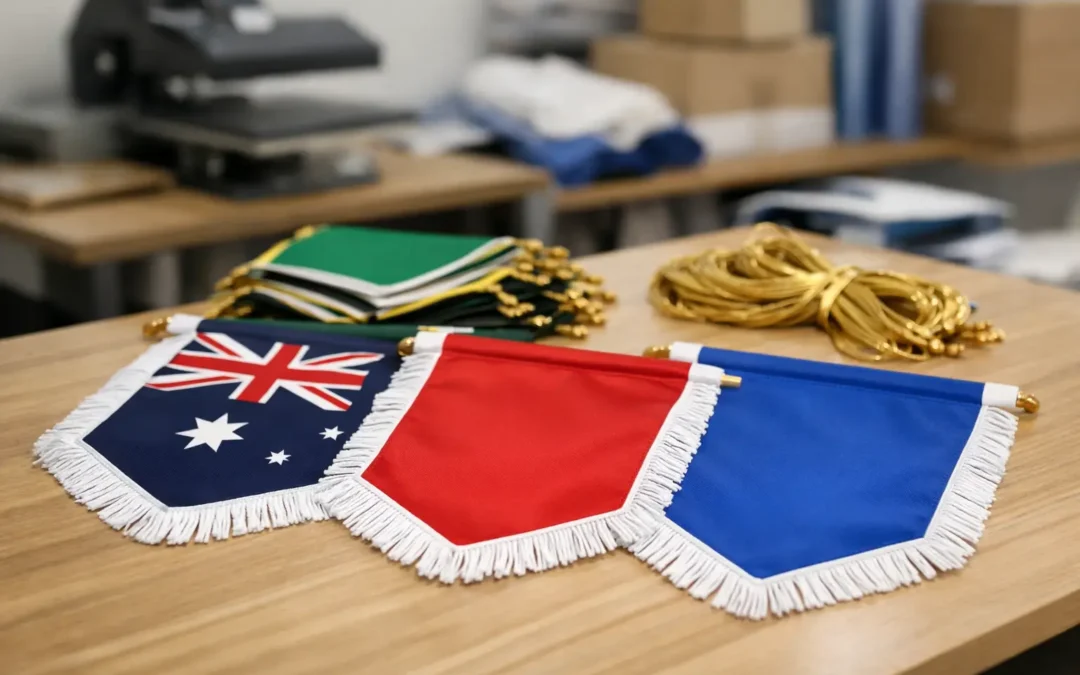
When a clubroom wall looks bare, a sponsor activation needs more presence, or an event pack feels unfinished, pennants are often the item that pulls the whole presentation together. For buyers sourcing custom pennants Australia-wide, the challenge is rarely just finding a printer. It is finding a supplier that can handle volume, get branding right, and deliver to deadline without turning a straightforward order into a drawn-out project.
Pennants sit in a useful space between display branding and promotional merchandise. They are compact, easy to distribute, simple to hang or present, and they carry a strong sense of occasion. That makes them a practical choice for sporting clubs, hospitality groups, schools, breweries, community organisations, venue operators and event teams that need branding with a bit more permanence than a flyer and more flexibility than a fixed sign.
Why custom pennants still work
A good pennant does two jobs at once. It acts as a branded display piece, and it also feels like a keepsake. That matters when you are supplying merchandise for tournaments, club exchanges, commemorative events, sponsor presentations or venue decor.
Unlike some promotional items that disappear into a drawer, pennants are usually put on display. They end up in clubhouses, bars, reception areas, offices, trophy cabinets and home collections. From a brand visibility point of view, that longer display life can make them a smart spend, especially when the artwork is clean and the production quality holds up.
They also suit bulk ordering. If you are running a national event, servicing multiple venues, or preparing club merchandise for a season launch, pennants are straightforward to allocate, pack and distribute. They are lightweight, relatively compact and suitable for orders that need to move across Australia without creating the freight challenges that come with larger display materials.
Choosing custom pennants in Australia for the right use
Not every pennant order has the same purpose, and that affects the best production approach. A pennant designed for a formal presentation can call for a different finish than one being handed out at a community event or sold through a club canteen.
For presentation pennants, buyers often want a more polished look. Tassels, stronger edging, richer colour reproduction and crisp logo placement tend to matter more because the item is part of a ceremonial moment. In these cases, visual quality carries weight, and cheap-looking finishing can undermine the brand or the event.
For promotional or supporter use, durability and value per unit may take priority. If the order is going out in larger numbers, the focus usually shifts to practical production choices that keep unit pricing under control while still maintaining a professional standard.
This is where experienced supply support matters. The most efficient orders start with a clear use case, because size, material, print method and finishing should all follow that purpose. Buyers who skip that step often end up paying for features they do not need, or cutting corners on details that actually matter once the pennants arrive.
What business buyers should decide early
The fastest custom orders usually come from buyers who lock in a few core details before artwork goes to production. Size is an obvious one, but shape is just as important. Traditional triangular and shield-style pennants both have their place, and the choice often comes down to logo layout and how much copy needs to fit on the face.
Material selection also affects the final result more than many first-time buyers expect. Some fabrics and finishes give stronger colour vibrancy, while others are chosen for feel, structure or cost control. If the pennants are being used for presentations or retail-style merchandise, texture and finish tend to carry more importance. If they are being ordered in volume for distribution, consistency and production efficiency may matter more.
Branding layout is another area where practical thinking beats guesswork. A pennant is not a brochure, so too much detail can work against it. Logos, event names, dates and sponsor marks need enough breathing room to stay legible. Clean artwork nearly always gives a better result than trying to force every brand element into a limited print area.
Then there is finishing. Hanging cords, tassels, stitched edges and reinforced tops can all improve the final presentation, but they need to match the budget and the purpose of the order. For some campaigns, those extras are worth it. For others, they add cost without adding much value.
Custom pennants Australia buyers should expect from a supplier
For commercial orders, product quality is only part of the job. Procurement teams and event managers need a supplier that can manage the order properly from artwork approval through to dispatch.
That means realistic lead times, not optimistic promises. Custom production always depends on quantities, artwork readiness, finishing requirements and freight timing. If a supplier glosses over those variables, the risk lands with the buyer when deadlines tighten.
Artwork support is just as important. Many logos look fine on a screen but need adjustment for small-format merchandise. Text alignment, bleed, colour matching and print clarity all need checking before production starts. A dependable supplier will raise issues early rather than pushing unsuitable artwork through and leaving the customer to deal with a weak result.
Consistency matters too, particularly for repeat orders or multi-location rollouts. If a business is ordering pennants for several venues or across a yearly calendar of events, the branding needs to remain stable from batch to batch. That is where working with a supplier built around business orders, rather than one-off novelty printing, makes a real difference.
Where pennants fit into broader branded merchandise
Pennants work best when they are part of a bigger presentation plan. For clubs and venues, they can support wall branding, commemorative displays and sponsor recognition. For events, they sit well alongside branded drinkware, signage, lanyards, apparel and giveaway merchandise.
That broader fit is often what makes them commercially useful. A pennant on its own can be a nice item. A pennant delivered as part of a coordinated event or venue branding package has more impact because it reinforces the same colours, logos and messaging already visible across the site.
This is particularly relevant for hospitality and event operators. If you are already managing branded glassware, bar presentation, table materials or activation stock, adding pennants can help create a more finished environment without moving into expensive large-format fit-out territory.
Common mistakes that slow down orders
One of the biggest issues is late artwork approval. Buyers sometimes treat pennants as a quick add-on item, but custom production still needs sign-off time. Waiting until the final week before an event is where avoidable stress begins.
Another common problem is underestimating quantity. Ordering too few can create uneven distribution across venues, teams or attendees, and reorder timing is not always ideal if the original production window has passed. It is usually more efficient to think through full allocation at the start, especially for wholesale pricing.
There is also the issue of overcomplicated design. Pennants tend to look best when the message is focused. A strong logo, a short line of text and a clear event or club identity usually outperform cluttered layouts with too many competing elements.
Finally, some buyers focus only on unit price and ignore finish, presentation and service. Cost matters, especially on volume orders, but the cheapest quote is not always the best commercial outcome if it leads to poor print quality, inconsistent branding or missed delivery windows.
Making the order process easier
The most efficient orders usually begin with a simple brief that covers intended use, quantity, preferred size, artwork status and delivery deadline. That gives the supplier enough information to recommend practical options instead of trading emails over basic details.
From there, the process should stay straightforward. Confirm the specification, check artwork carefully, approve the proof, and allow sensible production time. If you are ordering for a fixed event date, leave room for freight and any final packing requirements rather than planning everything to the last possible day.
For buyers managing multiple branded items, it also helps to work with a supplier that understands how pennants fit into the larger order. That can reduce admin, improve branding consistency and simplify delivery planning. For many businesses, that procurement efficiency is just as valuable as the product itself.
Custom pennants are not complicated, but they do reward good planning. When the spec is right, the artwork is handled properly and the supplier understands volume production, they become one of the more reliable pieces in the branded merchandise mix. If you need them to look sharp, arrive on time and work as part of a bigger brand presentation, a practical brief at the start will save time all the way through.