
A deck of cards rarely gets thrown out after one use. It sits behind the bar, in a hotel room drawer, in a club lounge, in a gift pack or in someone’s kitchen at home – and that staying power is exactly why promotional playing cards continue to work for business campaigns that need more than a short burst of attention.
For buyers managing budgets, deadlines and brand presentation, this product sits in a useful middle ground. It is affordable in volume, easy to customise and practical enough to be kept. That matters whether you are planning a venue activation, supplying merchandise for a brewery promotion, assembling event packs or sourcing branded items for hospitality groups and clubs.
Why promotional playing cards still perform
Some promotional products get attention for a day. Others become part of a customer’s routine. Promotional playing cards tend to fall into the second category because they are functional, familiar and suited to a wide range of settings.
They work well in hospitality because they encourage downtime and social interaction. They suit tourism and accommodation because they are compact, giftable and easy to place in rooms, welcome packs or retail counters. They also fit corporate and event use where buyers need a branded item with broad appeal that does not rely on sizing, charging cables or product instructions.
The main strength is repeat handling. A branded deck can be opened dozens or even hundreds of times over its life. Every use puts your logo, colours and message back in front of the customer. Compared with single-use print pieces, that gives the item a much longer promotional window.
That said, results depend on the execution. A flimsy deck with poor print alignment or weak packaging can do the opposite of what you want. If the cards feel cheap, the brand can feel cheap too. This is why production quality and artwork setup matter just as much as price.
Where promotional playing cards fit best
Not every business needs them, but for the right campaign they are highly effective. Venues, pubs, clubs and breweries often use playing cards as part of branded merchandise ranges, giveaway bundles or point-of-sale promotions. They feel relevant in social settings, and they are easy to hand out during launches, tastings and member promotions.
Hotels, resorts and tourism operators can also get good value from them. A deck placed in guest rooms or sold as a souvenir has both practical use and branding value. For event organisers, they are a sensible inclusion in sponsor packs, attendee bags or VIP gifts because they travel well and are easy to distribute in bulk.
Corporate buyers may use them differently. In that setting, the deck often works best as part of a broader branded set rather than a standalone item. Paired with drinkware, presentation packaging or event merchandise, it becomes part of a more considered brand experience.
The trade-off is relevance. If your audience has no obvious use for cards, another product may give better return. Buyers should always look at the campaign setting first, then match the item to how people will actually use it.
What customisation options matter most
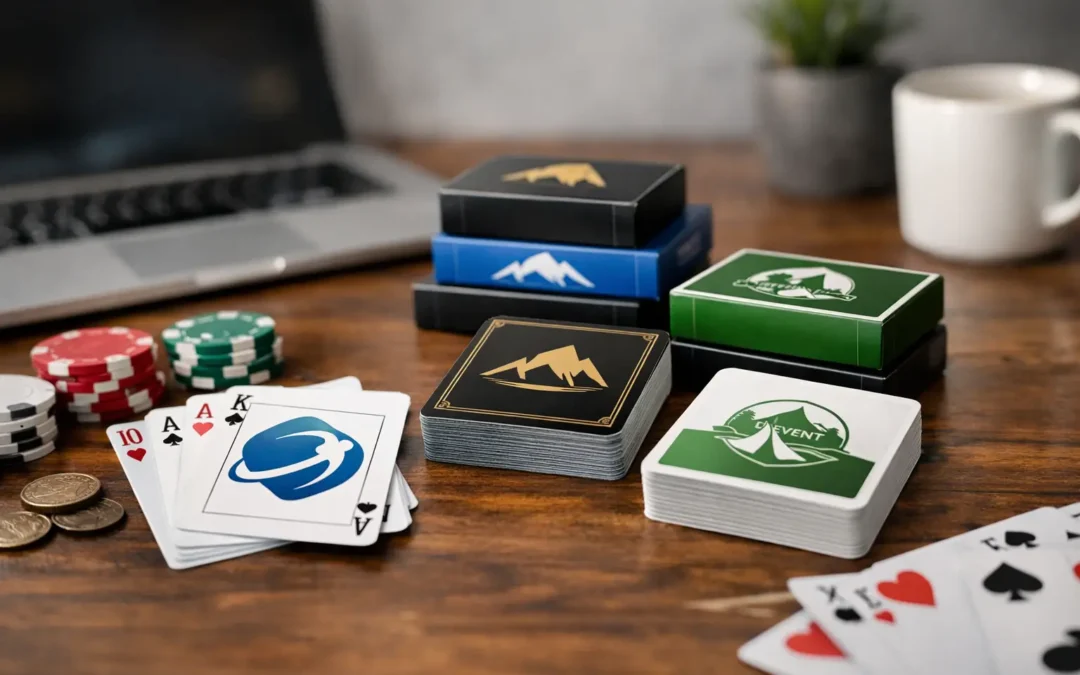
The most visible branding area is usually the box, and in many cases that is where the strongest branding result comes from. A well-designed tuck box gives you a clean surface for logos, colours, campaign messages and contact details. It is also the first thing people see before the deck is opened.
Card back printing is another strong option because it appears throughout use. If the deck is being handled repeatedly in venues or at social events, branded backs can reinforce your visual identity without making the cards harder to use. This is often the best balance between brand presence and practicality.
Custom face cards or jokers can add another layer of branding, but this depends on your budget and intended use. Fully custom internal print can look impressive, especially for special releases or themed campaigns, though it adds complexity to artwork and production. For many bulk buyers, branded packaging plus custom card backs is the more efficient choice.
Finish matters as well. A smooth, durable coating helps the cards shuffle properly, handle better and last longer. If the product feels sticky, thin or poorly cut, users notice straight away. In promotional merchandise, tactile quality often carries more weight than expected.
Artwork and print quality are not small details
This is one of those products where poor artwork setup shows quickly. Fine lines, small text, low-resolution logos and weak colour matching can all affect the final result. With promotional playing cards, buyers should think about the item as both a print job and a functional product.
Packaging design needs clear hierarchy. Your logo should be easy to identify, but the deck should still look like something people want to keep. Overloading the box with too much copy, too many colours or cluttered artwork can reduce the perceived value.
Consistency also matters if the cards are part of a wider merchandise range. If you are ordering branded glassware, coasters, bar runners, event signage or giveaway items alongside the deck, the look and finish should align. That creates a stronger overall presentation and a more professional result on the table, bar or display shelf.
An experienced supplier can help flag practical issues early, such as bleed areas, safe zones, print limitations and carton quantities. That is especially useful for buyers who do not order custom printed products every week but still need the job done properly.
Ordering promotional playing cards in bulk
Bulk buying changes the decision-making process. Unit price matters, but so do lead times, minimums, freight planning and packing configuration. A good product at the wrong delivery date is still the wrong product.
For campaigns with fixed launch dates, procurement teams should confirm artwork deadlines, proof approvals and dispatch timing early. Playing cards may look simple, but custom production still involves print setup, manufacturing and packing. Leaving approval to the last minute increases the risk of errors or delays.
Carton quantities are worth checking too. If you are distributing across multiple venues, event sites or retail points, you need to know how the stock will be packed and shipped. A supplier that understands commercial orders can help plan this more efficiently, particularly for national rollouts or multi-site hospitality groups.
It is also worth deciding upfront whether the cards are for giveaway, retail resale or inclusion in a premium pack. That affects both budget and finish. A low-cost event giveaway may call for straightforward branding and standard packaging. A merchandise item sold at a venue or brewery may justify a more polished presentation.
How to judge value, not just price
Cheap promotional products can look attractive on a spreadsheet and disappointing in person. With playing cards, value comes from the balance of print quality, card durability, presentation and repeat use.
A deck that lasts longer and looks better may provide stronger brand exposure even if the unit cost is slightly higher. That is particularly true for hospitality, tourism and events, where presentation reflects directly on the business. Customers notice the difference between a deck that feels deliberate and one that feels like a rushed giveaway.
This is where working with a practical, trade-focused supplier helps. The conversation is not only about the item itself. It is also about how it will be branded, where it will be used, what quantity is required and how quickly it needs to move. For Australian buyers managing multiple products and campaign deadlines, that kind of support reduces friction.
ABC2000’s customer base often needs exactly that sort of dependable supply approach – clear options, realistic production advice and branding that holds up in commercial settings.
When promotional playing cards make the most sense
If your business needs a branded product that is compact, cost-effective in volume and likely to stay in circulation, playing cards are a strong option. They suit social environments, travel well, and give you more repeat exposure than many short-life promotional items.
They are not the right fit for every campaign, and that is fine. The best promotional product is the one that matches the audience, the setting and the timeline. But when the goal is practical use, broad appeal and reliable branding space, promotional playing cards are hard to overlook.
Choose the deck the same way you would choose any visible branded item – with a clear use case, solid artwork and production quality that reflects your business properly. If the product feels worth keeping, your branding has a much better chance of being kept with it.