
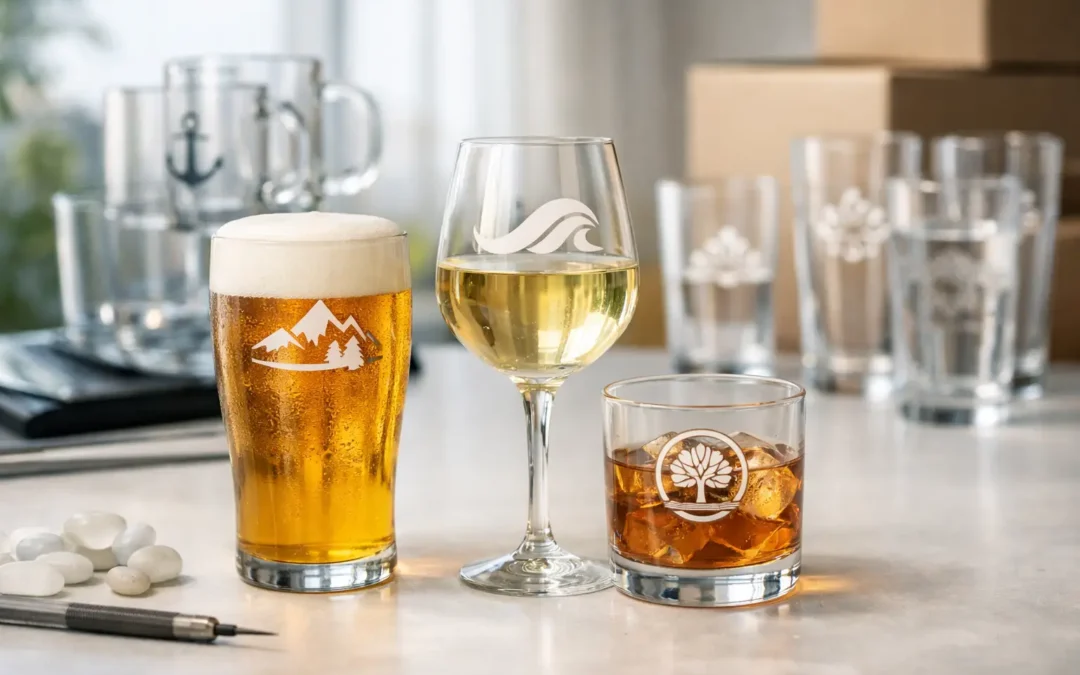
A branded beer glass with a logo that disappears behind a customer’s hand, or a wine glass with a print that chips after a few commercial washes, does not do the job. Knowing how to brand glassware correctly means matching the glass, artwork and decoration method to the way the product will actually be used. For hospitality venues, breweries, clubs and event organisers, those decisions protect both the presentation of the brand and the value of a bulk order.
Glassware is a high-visibility promotional product. It is held, photographed, raised in a toast and repeatedly used at the bar or table. That makes it an effective branding surface, but it also comes with practical production limits. Glass shape, print area, wash requirements and order timing all need to be resolved before production starts.
Start with the purpose of the glassware
The right branded glass is not always the most expensive one or the largest available. Begin with the serving occasion. A brewery may need pint glasses or tasting paddles that suit a specific beer range. A restaurant may require wine glasses that support a more refined table setting. A corporate event may prioritise a versatile tumbler that guests can take home and use again.
Think about who will use the glass, how often it will be washed, and whether it needs to work across multiple drinks. A busy venue needs a practical, commercial-grade option with a decoration method suited to repeated handling. A short-run event giveaway may place more emphasis on impact, colour and unit price. The best choice depends on the job, not simply the glass style.
Capacity matters too. If you are supplying a beverage product, confirm the required fill line and whether measurement markings are needed. For venues, also consider how the glass stacks, stores and fits into existing service routines. A striking shape can attract attention, but an awkward glass may create avoidable issues behind the bar.
How to brand glassware correctly with the right method
The branding method should be selected around the artwork, order quantity and intended use. Printing and laser etching each create a different result, and neither is automatically better in every situation.
Screen printing for colour and strong logo visibility
Screen printing applies ink directly to the glass and is a practical choice for bold, clean artwork. It works particularly well for one-colour logos, simple text and repeat venue branding where immediate visibility is the priority. Multi-colour artwork can be produced, although each additional colour generally adds set-up, registration and production considerations.
For high-use hospitality glassware, ask about the print’s suitability for commercial washing. A lower-cost print option may be acceptable for a one-off promotion, but a venue that cycles glasses through industrial dishwashers needs branding designed to hold up over time. Providing a realistic use case early helps avoid specifying the wrong finish.
Laser etching for a permanent, understated finish
Laser etching removes a fine layer from the glass surface to create a crisp, frosted mark. It is a strong option for wine glasses, whisky tumblers, corporate gifts and premium barware. Because the design is etched rather than printed in ink, it offers excellent longevity and a polished appearance.
The trade-off is colour. Laser etching produces a tonal finish, not a full-colour logo, so it is best suited to artwork that remains recognisable in one colour. Fine detail can work well when prepared properly, but very small type, dense shading or intricate photographic elements may lose clarity. A simplified logo version often gives the best result.
Consider the shape before approving the decoration
A glass is rarely a flat surface. Tapered pint glasses, curved wine bowls and fluted champagne glasses can affect how artwork appears once applied. A wide logo may need to be reduced or repositioned to avoid wrapping too far around the curve. Likewise, a design that looks centred on a flat proof may appear off-centre when viewed through the glass or filled with a dark beverage.
Experienced suppliers account for available decoration areas, but buyers should still check the proof with the final glass shape in mind. Do not assume the artwork can be enlarged to fill every visible part of the product. Keeping sensible margins produces a cleaner finish and reduces the risk of distortion.
Prepare artwork for a clean production result
Artwork preparation is where many avoidable branding problems begin. A logo copied from a website, saved as a low-resolution image or supplied as a screenshot may look acceptable on screen but will not reproduce cleanly on glass.
Where possible, provide vector artwork in an editable format such as AI, EPS or PDF. Vector files allow the design to be scaled without becoming soft or pixelated, and they make it easier to separate colours and adjust fine details for the selected decoration process. If only a raster image is available, it should be high resolution and supplied at the intended print size.
Keep the design practical. Hairline strokes, tiny reversed text and close-together elements can fill in during printing or become hard to read when etched. As a general rule, simplify rather than force every detail onto a limited print area. The logo needs to be recognised from a normal serving distance, not examined with a magnifying glass.
If brand colours are essential, supply the relevant Pantone references rather than relying solely on colours shown on a monitor. Screen settings vary, and glass can alter the way a printed colour is perceived. A solid colour match may also look different against clear, tinted or frosted glass. Clarifying the required finish at the artwork stage prevents disappointment later.
Get placement right for the customer experience
Brand placement needs to work when the glass is in use. For most bar and event applications, a front-facing logo placed opposite the drinker provides the clearest visibility to other guests. This is often called a facing position and is a reliable choice for venue logos, sponsors and campaign marks.
However, placement should not be treated as a default. A large mark can be obscured by a hand if it sits too low. Branding near the rim may interfere with the drinking experience or look crowded. On wine glasses, placing a logo on the bowl can offer stronger visibility, while a small etched mark toward the lower bowl may feel more premium. Consider the intended result: prominent promotional exposure, subtle hospitality branding, or a gift-quality finish.
When branding includes legal wording, a fill line or a secondary logo, make sure each element has adequate separation. Trying to place too much information on one glass usually weakens the main message. In most cases, one well-positioned logo will outperform a crowded collection of marks.
Approve proofs carefully before bulk production
A production proof is not a formality. It is the point where product selection, artwork and placement come together. Check the spelling, logo version, print colour, decoration size and location. Confirm whether the proof represents the actual glass model and whether the displayed branding area is to scale.
For larger orders, branded glassware should be approved with the same care as other customer-facing printed material. A small error repeated across hundreds or thousands of units is expensive to correct and can put an event date at risk. If the glasses are for a launch, festival or venue opening, build proof approval into the project schedule rather than leaving it until the final days.
It is also worth confirming pack quantities, delivery address details and access requirements for the site. Glass is fragile freight, and a delivery to a warehouse, club or event venue may need to be timed around receiving hours. Clear instructions help the order move from production to delivery without unnecessary delays.
Plan quantities, lead times and spares
Bulk purchasing improves unit pricing, but ordering the exact guest count is rarely enough. Hospitality operations need replacement stock, and events can have breakages during set-up or service. Ordering a sensible overage gives the team room to operate and avoids the cost of a small follow-up run later.
Lead time depends on stock availability, the branding method, artwork readiness and the scale of the order. Custom glassware is a production item, not an off-the-shelf purchase once a logo is added. Allow time for artwork checks, proof approval, decoration, packing and Australia-wide freight. If an event deadline is fixed, raise it at the beginning of the enquiry so the production pathway can be planned accordingly.
ABC2000 supports commercial buyers with custom drinkware options, artwork handling and bulk-order coordination, helping keep these practical details under one supplier process.
A branded glass earns its place when it looks right on the table, survives the demands of service and keeps the logo visible long after the event ends. Start with the use case, supply production-ready artwork and allow enough time to approve the details properly. That is how a bulk glassware order becomes a dependable part of your brand presentation.