
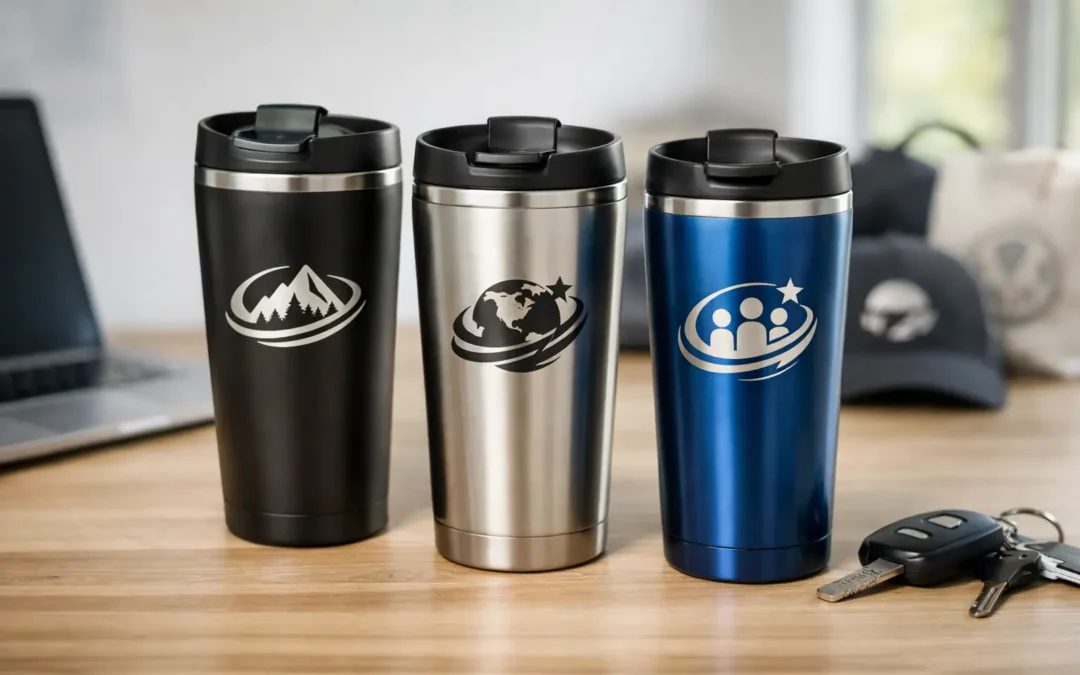
A travel mug is only useful when it earns a place in the daily commute, on a worksite, in a meeting room or behind a venue counter. That is why stainless steel travel mugs are a strong choice for branded merchandise campaigns: they are practical, visible and built for repeat use. For business buyers, the opportunity is not simply to add a logo. It is to put a well-presented, useful item in front of customers, staff or members often enough that the brand becomes familiar.
Unlike single-use event giveaways, quality drinkware can remain in circulation for months or years. That makes product selection, decoration method and production timing worth getting right from the start.
Why Stainless Steel Travel Mugs Work for Bulk Branding
Stainless steel has a professional feel that suits corporate promotions, staff onboarding, venue merchandise, brewery ranges and hospitality supply. It is durable, easy to maintain and generally better suited to regular use than lighter promotional alternatives. A travel mug also has a clear job to do: carrying coffee, tea or cold drinks away from home or the office.
That everyday function gives a logo more exposure than an item that sits in a desk drawer. A branded mug can travel in a car cup holder, sit on a workstation, be carried through an event or used by a team during early starts. For clubs, councils and organisations with field staff, it is a practical piece of kit rather than a novelty.
The value depends on the intended recipient and the quality level selected. A premium insulated mug can support a client gift, executive pack or retail merchandise range. A simpler single-wall option may better suit a high-volume conference, community campaign or staff activation where unit price is the main consideration. The right answer is usually about the campaign purpose, not just the lowest initial cost.
Choosing Stainless Steel Travel Mugs for Your Audience
Start with how and where the mug will be used. Commuters usually value a secure lid, comfortable grip and a shape that fits common vehicle cup holders. Hospitality businesses may prioritise a clean silhouette, brandable surface and reliable replacement supply. Event organisers often need a practical capacity, clear artwork placement and delivery certainty for a fixed event date.
Insulation and wall construction
Double-wall, vacuum-insulated mugs are designed to help maintain drink temperature for longer and reduce condensation on cold beverages. They are a sensible choice for premium campaigns, staff gifts and products expected to be used throughout a working day. They also carry a higher unit cost, so they are not always necessary for mass distribution.
Single-wall stainless steel travel mugs are typically lighter and more economical for larger runs. They can work well for short-term promotions, fundraising merchandise and busy events, particularly where recipients are likely to use the mug soon after receiving it. Be clear about the expected use before specifying insulation. Promising all-day heat retention from a basic construction creates avoidable disappointment.
Capacity, lid style and practical handling
Capacity affects both usability and branding. Smaller mugs can suit espresso drinkers and compact commuter bags, while larger capacities appeal to drivers, trades, offices and outdoor events. Consider whether the recipient is likely to carry a standard takeaway coffee, make a drink at home, or keep a larger beverage at their desk.
Lid design matters just as much. A screw-top or securely sealed lid is often preferred for travel, while a slide lid can be convenient for desk use. No drinkware should be positioned as completely leakproof unless the product specification confirms it. A practical product description that reflects real use will protect both the campaign and the brand behind it.
Check the overall dimensions as well. A mug that looks good in a catalogue may be too tall for a coffee machine, too wide for a cup holder or awkward to clean. For volume orders, asking these questions early is far easier than dealing with unsuitable stock after delivery.
Finish and colour selection
Brushed steel, matte powder-coated colour, painted finishes and contrast components each create a different result. Brushed stainless steel offers a clean, industrial look and can be particularly effective with laser etching. Powder-coated colour provides stronger visual impact and can help align the mug with established brand colours, event themes or team uniforms.
Darker finishes can make light-coloured printed artwork stand out, while a laser-etched mark may reveal the steel beneath for a refined, permanent-looking result. Lighter colours are useful for bold dark artwork, but can show wear more easily in demanding environments. If the mugs will be used by venue staff, on worksites or at outdoor events, choose a finish that suits the conditions rather than only the artwork proof.
Branding Methods That Suit Travel Mugs
The best decoration method depends on the mug material, surface shape, logo detail, print colours and required quantity. Artwork should be reviewed before production so the chosen method supports the intended finish.
Laser etching is often the preferred option for stainless steel travel mugs where a durable, understated result is wanted. It suits logos, names and simple graphic marks, especially on coated mugs where the etching creates a contrasting reveal. It is well suited to premium corporate gifts, hospitality merchandise and repeat-use staff drinkware. Fine details can have limitations, so artwork may need adjustment to reproduce clearly.
Pad printing can be useful for smaller logo areas and straightforward designs. Screen printing can suit bolder artwork and larger print areas, depending on the product shape and coating. Full-colour digital applications may be appropriate where artwork includes gradients or more complex colour detail, although the available decoration area and surface construction need to be considered.
For a campaign that needs individual names, numbered mugs or variable details, discuss personalisation early. It can add considerable value for staff recognition, member programs and VIP event packs, but it changes production planning and artwork preparation. Supply a clean vector logo where possible, along with nominated brand colours and any font requirements. This reduces approval delays and helps ensure the finished mugs match other branded materials.
Planning a Bulk Order Without Last-Minute Pressure
Bulk promotional drinkware is often tied to a deadline: a conference opening, a venue launch, a staff program, Christmas gifting or an event bump-in date. The most dependable way to meet that date is to work backwards from the required delivery day, allowing time for artwork approval, production, packing and freight to the final Australian destination.
Order quantity should account for more than the guest list or staff count. Consider whether you need spare units for late registrations, replacement stock, VIP packs, media kits or future starters. Ordering a small buffer with the main production run is generally more efficient than trying to match a custom product later.
Freight requirements also deserve attention. Travel mugs are more substantial than flat printed items, and carton volumes can add up quickly for large orders. Confirm whether delivery is going to one warehouse, several branches, an event venue or individual recipients. If stock must be separated into kits or delivered in stages, that should be part of the quoting and fulfilment conversation rather than an afterthought.
Budgeting should include the whole outcome: the mug, decoration, setup where applicable, packaging and delivery. A lower-priced product may lose its advantage if the branding is poorly suited to the surface or if the product does not meet the recipient’s expectations. Conversely, a well-chosen mid-range mug can provide a stronger cost-per-use result because people keep reaching for it.
Getting the Artwork and Presentation Right
A travel mug has a curved surface, so artwork needs room to breathe. Logos placed too close to the edge of a print area can look cramped or distort around the curve. Simple, high-contrast branding usually performs best, particularly when the mug will be seen at a distance in a café queue, office kitchen or event space.
Think about which side will face the user and which side will face everyone else. For a right-handed drinker, a logo placement can be selected to maximise outward visibility when the mug is held. For venue merchandise, a centred front mark may be the better retail presentation. There is no universal placement, but there should be an intentional one.
Packaging can also change the perceived value. Individual boxes are useful for corporate gifting, online fulfilment and premium presentation. For high-volume internal distribution, bulk packing may be more economical and reduce unnecessary material. The appropriate choice comes back to the campaign: a staff mug handed out at a toolbox meeting needs a different presentation from a client gift delivered with a welcome pack.
ABC2000 can help business buyers move from product selection to artwork approval and bulk delivery with a process suited to commercial orders. A clear brief covering quantity, deadline, destination, brand artwork and intended use gives the production team the information needed to recommend a suitable option.
The best branded travel mug is the one recipients genuinely use. Choose a specification that fits their routine, apply branding with purpose and allow enough time for a properly managed production run. The result is practical merchandise that keeps working long after the event banners come down.