
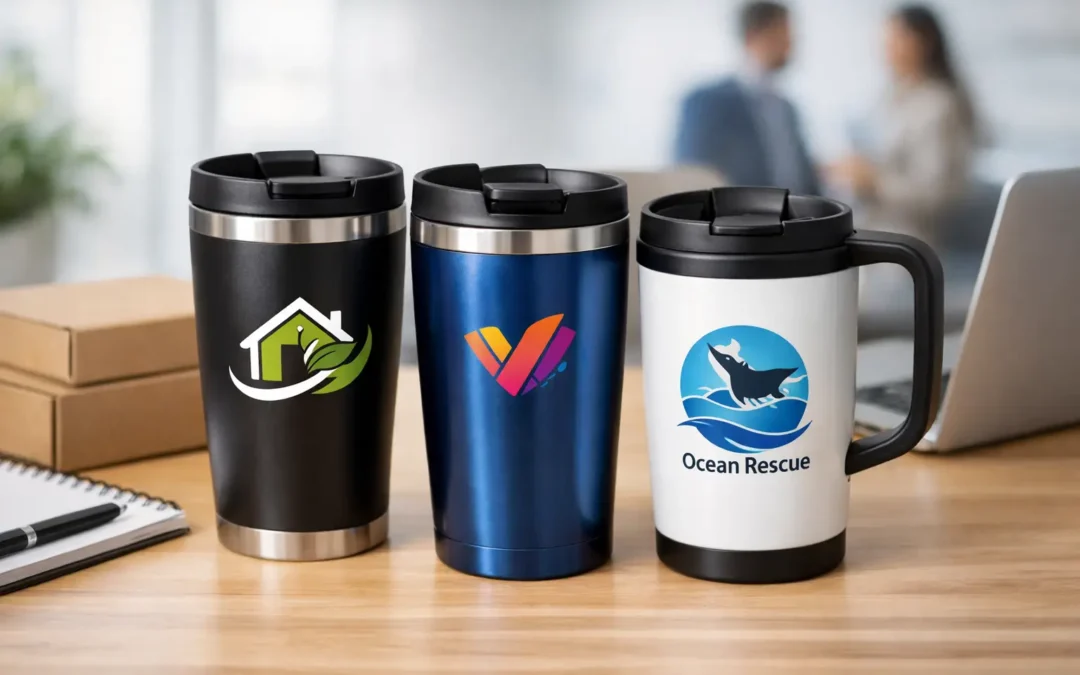
A travel mug is one of the few promotional products that earns repeat visibility before 9 am. It travels from the kitchen bench to the car, train platform, office and job site, putting a business name in front of the people who matter without feeling like throwaway advertising. For organisations buying customised travel mugs wholesale, the real value lies in choosing a mug that suits the user, the brand application and the quantity required – then allowing enough time to produce it properly.
For Australian businesses, branded travel mugs work across staff programmes, customer promotions, hospitality partnerships, conferences, club merchandise and venue operations. They are practical, highly visible and available in formats that can support both budget-led campaigns and premium corporate gifting.
Why travel mugs perform in bulk promotions
A well-chosen travel mug has a longer working life than many event giveaways. People use it because it solves a familiar problem: carrying coffee, tea or cold drinks without relying on disposable cups. That utility gives the branding more opportunities to be seen, especially when the mug is comfortable to carry, easy to clean and dependable on the daily commute.
Bulk purchasing also creates consistency. A national sales team, a brewery’s merchandise counter or a large conference can use the same branded drinkware across multiple locations. The result is a more controlled visual presentation than buying assorted retail mugs or leaving individual branches to source their own products.
The right product depends on the purpose. A lower-cost plastic or double-wall tumbler may be appropriate for a large event where unit price is the priority. For client gifts, executive packs or staff recognition, stainless steel vacuum mugs generally provide a stronger perceived value and longer lifespan. Paying more for insulation or a refined finish is worthwhile only when the audience will notice and use it.
Choosing customised travel mugs wholesale by use case
Start with where and how the mug will be used. This is more useful than selecting solely by colour or capacity, as it narrows the product range quickly and helps avoid expensive mismatches.
Staff and corporate programmes
For employees, consider a durable insulated mug with a secure lid, a practical capacity and branding that remains clear after regular use. Stainless steel options with powder-coated finishes are popular because they feel substantial and offer a clean surface for logo decoration. A 350 ml to 500 ml size suits most coffee runs and desk use, although larger capacities can suit field crews and drivers.
If the order is for onboarding kits or an annual staff initiative, choose a style likely to remain available for repeat orders. Consistent product supply matters when new starters join months later and the business wants the same presentation.
Events, conferences and campaigns
Event buyers often need volume, controlled spend and delivery to a firm date. In these cases, simple travel tumblers or reusable cups may offer the best balance of price and impact. The branding should be clear at a glance, with enough contrast between the logo and mug colour to work in busy event environments.
A conference giveaway does not always need maximum insulation performance. It does need to be easy to distribute, packaged sensibly and durable enough to make it home with the attendee. When deadlines are tight, product availability and artwork readiness become just as important as the selected model.
Hospitality, venues and merchandise sales
Cafes, breweries, clubs and venues can use branded travel mugs as retail merchandise, loyalty rewards or reusable drinkware for members. Here, the design carries more weight. A laser-etched stainless steel finish can feel premium and understated, while a bold screen print may better suit a lively venue identity.
Consider the customer’s routine. A slimline mug may fit more vehicle cup holders, while a larger handled model can suit outdoor venues, campers or tradies. If the mug will be sold, sample approval is especially valuable. It lets the buyer assess lid operation, drink opening, weight and the finished branding before committing to a larger run.
Material, lid and insulation are commercial decisions
Travel mugs are not interchangeable. Material affects price, performance, decoration options and the perceived quality of the finished item.
Plastic and polypropylene options are generally lighter and can be effective for high-volume promotions. They are often suitable where the aim is reusable branding at an accessible unit cost. However, they may not provide the premium feel or temperature retention expected from a corporate gift.
Stainless steel is a reliable choice for durability and a higher-value presentation. Single-wall stainless styles are useful for cold drinks or short-term use, while double-wall and vacuum-insulated models are better suited to hot drinks and all-day commuting. Vacuum construction usually comes at a higher price point, but it supports a stronger gift proposition and can improve the likelihood of long-term use.
The lid deserves the same scrutiny as the body. A screw-top lid, slide closure or flip lid each creates a different user experience. Leak resistance is particularly relevant for drivers, travellers and staff working between sites, but buyers should avoid promising a mug is completely leak-proof unless that product specification confirms it. Ask how the lid seals, whether it is designed for one-handed drinking and whether handwashing is recommended.
Select a branding method that suits the product
Branding should complement the mug material and the artwork, not simply fill available space. A fine, detailed logo may need a different process from a bold one-colour mark. Artwork supplied in a suitable format also reduces delays at proofing stage.
Screen printing is a practical option for bold logos and straightforward colour applications. It works well for campaign branding where strong visibility matters. Pad printing can suit curved surfaces and smaller print areas, depending on the product. Full-colour wrap printing can create an attention-grabbing result where the mug is designed to accept it, but it is not the right choice for every shape or finish.
Laser etching is particularly effective on many stainless steel travel mugs. It creates a permanent, refined mark by revealing the underlying material or contrasting layer. This method suits corporate logos, names and minimalist artwork, and it avoids the look of a surface print that may not match a premium product. The trade-off is that laser etching does not reproduce full-colour artwork.
Before production, review a digital artwork proof carefully. Check logo position, spelling, print colours, orientation and whether the branding will face the user or the people around them. For a mug used in the right hand, the logo position can change who sees it most often. That small decision matters more than it first appears.
Plan quantities, lead times and delivery early
Wholesale pricing improves with volume, but the cheapest unit price is not automatically the best buying decision. Ordering significantly more than required can create storage issues, while an order that is too close to the needed quantity leaves no room for damage, late registrations or additional staff. For events, a sensible contingency quantity is often worth considering.
Lead time is shaped by stock availability, branding method, artwork approval, production scheduling and freight destination. Custom production cannot begin until artwork is approved, so internal sign-off should be organised before the deadline becomes urgent. If multiple stakeholders need to approve a logo or campaign message, provide them with a clear proof deadline rather than waiting until production is due to start.
Australian buyers should also factor in delivery to regional sites, multiple branches or event venues with restricted receiving hours. A single delivery point can simplify freight and distribution, but direct delivery to several locations may save internal handling time. The best approach depends on the size of the programme and who is responsible for final distribution.
What to provide when requesting a quote
A clear brief makes the ordering process faster and reduces avoidable revisions. Include the preferred mug style or intended use, estimated quantity, required delivery date, delivery postcode and branding requirements. Supplying vector artwork, such as AI, EPS or print-ready PDF files, is generally the best starting point for clean logo reproduction.
It also helps to state whether price, premium presentation, insulation, colour matching or turnaround is the primary priority. These requirements can pull in different directions. A premium vacuum mug with multi-colour decoration may be ideal for a small client gift programme, while an in-stock one-colour option may be the smarter choice for 2,000 event attendees needed within a short timeframe.
ABC2000 works with business buyers to match the product, decoration method and production plan to the job at hand. That practical support is valuable when an order involves more than selecting a mug from a catalogue – particularly where brand consistency, artwork handling and delivery timing all need to line up.
A travel mug should feel useful enough to stay in the daily routine, and branded well enough to represent the business every time it is carried. Get those two details right before approving the order, and bulk drinkware becomes a lasting part of the brand’s everyday visibility.