
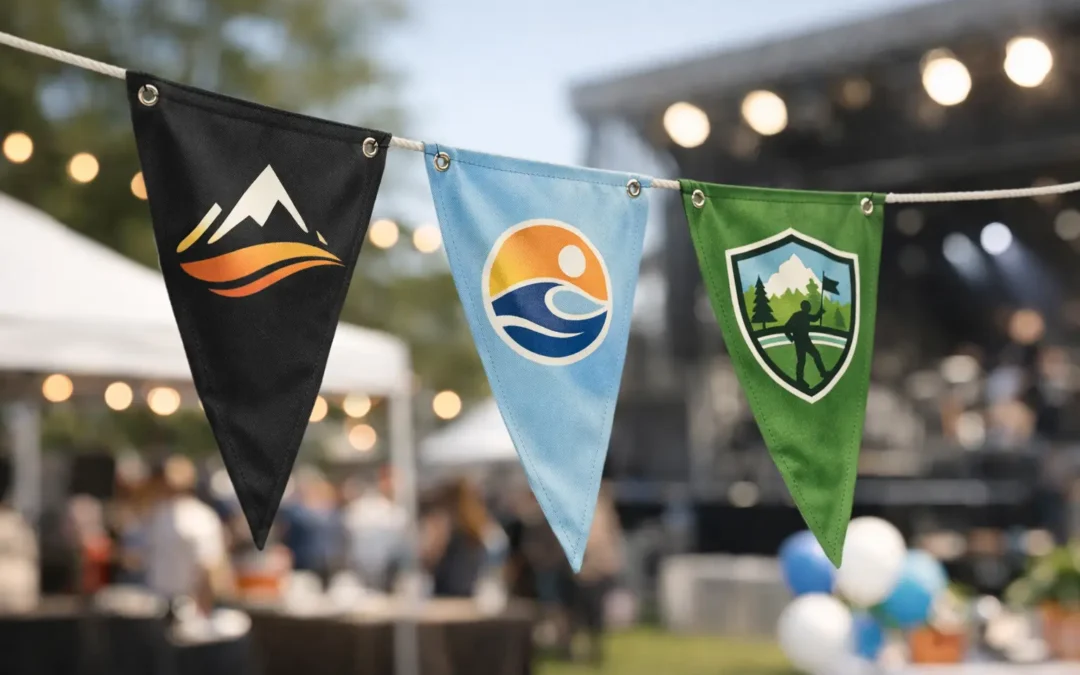
A blank wall at a club, brewery or event space can make even a well-run venue feel unfinished. Custom fabric pennants solve that quickly. They add colour, reinforce branding and give you a display item that feels more permanent and considered than temporary paper signage.
For business buyers, the value is not just visual. Pennants are practical branded display pieces that work across promotions, venue fit-outs, sponsorship activations and commemorative merchandise. When ordered properly, they are easy to reproduce at scale, simple to distribute and reliable across multiple locations or campaign dates.
Where custom fabric pennants work best
Custom fabric pennants suit environments where brand visibility needs to feel established rather than disposable. Sporting clubs use them for team rooms, milestone events and sponsor displays. Breweries and hospitality groups use them to add character behind the bar, in tasting rooms or at festival stands. Schools, community organisations and corporate teams often use them for awards, presentations and internal events.
They also work well when you need branded pieces that travel. A pennant is lightweight, packs flat and can be moved between trade shows, event booths, pop-up activations and venue locations without much effort. That matters when your marketing team or operations team is setting up under deadline.
There is also a merchandising angle. A well-produced pennant can sit alongside drinkware, branded glassware, apparel or event accessories as part of a broader branded range. For organisations already investing in merchandise, pennants can fill the gap between decorative signage and saleable memorabilia.
Why fabric pennants still hold value
Digital screens have their place, but not every branded environment needs motion graphics and power access. Fabric pennants bring a different kind of presence. They feel tactile, traditional and credible, particularly in venues, clubs and hospitality settings where atmosphere matters.
They also carry a perceived value that lightweight posters often do not. A stitched or well-finished fabric pennant can feel commemorative, which is useful for anniversaries, tournaments, partnerships and one-off events where people want a keepsake rather than a throwaway item.
That said, the right application depends on your objective. If you need a message changed every week, fabric may not be the best fit. If you need branding that lasts beyond a single event and still looks intentional after repeated use, it becomes a stronger option.
Choosing the right custom fabric pennants for your use
Not all pennants serve the same purpose, and this is where bulk buyers benefit from getting specific early. The shape, fabric, finish and branding method all affect how the product performs in the real setting.
A traditional triangular pennant works well for clubs, team recognition and heritage-style branding. A swallowtail shape can feel more premium or ceremonial. Rectangular banner-style pennants may suit sponsor displays or venue branding where logo clarity matters more than nostalgia.
Fabric choice matters as well. Some materials are selected for a softer, classic look, while others are chosen for brighter print results or better durability. If the pennants are purely decorative and used indoors, presentation may be the main concern. If they will be handled often, packed for transport or reused over multiple campaigns, durability becomes more important.
Finishing details should not be treated as an afterthought. Trim, edging, hanging cords, rods and tassels all change the look and can influence whether the end result feels promotional, commemorative or retail-ready. For a hospitality group or event organiser, consistency across these details is often what separates a polished rollout from a mix-and-match result.
Artwork and branding considerations
A pennant has limited space, so artwork needs discipline. Logos that reproduce well on glassware or cartons do not always translate cleanly to fabric, especially on smaller formats or pointed shapes. Buyers often get the best result by simplifying the layout rather than trying to include every brand element.
Strong contrast usually helps. Clear logos, readable type and a restrained colour palette tend to hold up better from a distance. If the pennants are intended for wall display in darker venues, artwork may need to be adjusted for visibility rather than just brand guideline accuracy.
This is also where production method matters. Some branding methods suit bold block designs, while others allow more detail. There is always a trade-off between cost, finish and complexity. For high-volume campaigns, the smartest option is often the one that protects consistency across the full run rather than the one that looks best on a single sample.
For procurement teams and marketers, artwork approval should include practical checks. Ask how fine details will reproduce, whether colours are being matched closely or approximately, and how placement is controlled across volume. Those questions save time later.
Bulk ordering without surprises
The biggest mistake in ordering custom display products is treating them like generic merchandise. Pennants involve multiple variables, and small specification gaps can create production issues. If your order includes different designs, event dates or delivery points, that needs to be planned upfront.
Start with intended use. Are the pennants for internal decoration, retail sale, sponsor presentation, giveaways or a one-off ceremony? That affects fabric selection, finishing and packaging. A presentation pennant may need an upgraded finish. A volume giveaway item may need a sharper focus on unit price and speed.
Timelines matter as much as specs. If artwork is not final, if approvals sit across several stakeholders, or if delivery is needed before a launch date, build in enough lead time. Bulk custom work runs more smoothly when approvals, quantities and branding details are locked early.
Freight and fulfilment should also be considered. Pennants are compact, but large national campaigns can still involve split deliveries, staged production or multiple site allocations. For Australian businesses managing events across several states, supplier coordination becomes part of the value.
How custom fabric pennants support wider brand presentation
Pennants work best when they are not treated as isolated products. They are part of a broader visual program. In a venue, that may include branded glassware, coasters, bar runners, signage and staff-facing promotional material. At an event, it may sit alongside lanyards, drinkware, apparel and display items.
That broader view is where experienced wholesale supply matters. A buyer is not just choosing an item. They are managing consistency across products, timelines and branding methods. When display items and promotional merchandise are planned together, colours, logos and finishes are more likely to align.
For clubs and breweries, this can be particularly effective. A heritage-style pennant on the wall, branded glassware at the bar and matching event merchandise create a more complete brand environment. The individual items are simple. The impact comes from consistency.
ABC2000 works with businesses that need that kind of practical coordination – not just one product, but branded items that support the full presentation of a venue, event or campaign.
Common buying decisions that depend on budget
Budget always shapes the final choice, but cheapest is not always most efficient. If the pennants are for a short promotion, a simpler construction may make sense. If they are for ongoing venue display, paying more for better finish and durability can reduce replacement costs and preserve presentation.
Quantity can change the equation too. Larger runs may improve unit pricing, but only if the design is stable and the demand is real. Ordering excess stock for a one-off event is not helpful if branding changes six months later. On the other hand, under-ordering can create inconsistencies if a second run ends up with slight colour or production variations.
The best commercial decision usually balances unit price, expected lifespan and branding importance. A commemorative pennant presented to sponsors or VIPs should not be specified the same way as a general promotional handout.
What to ask before placing an order
Before proceeding, buyers should confirm the size, shape, fabric, branding method, finish, packing requirements, lead time and delivery schedule. It is also worth checking how artwork is supplied and approved, especially if multiple versions are involved for different teams, venues or sponsors.
If you are ordering for a campaign with hard dates, ask what can affect turnaround. That includes artwork changes, proof approvals and freight timing. Clear communication at the start usually prevents the kind of last-minute pressure that no event team wants.
A good pennant order is not complicated, but it does reward careful setup. The more clearly the end use is defined, the easier it is to get a result that looks right, arrives on time and performs as expected.
If your brand needs a display piece that is lightweight, practical and built for repeat visibility, custom fabric pennants are still one of the most effective options on the table.