
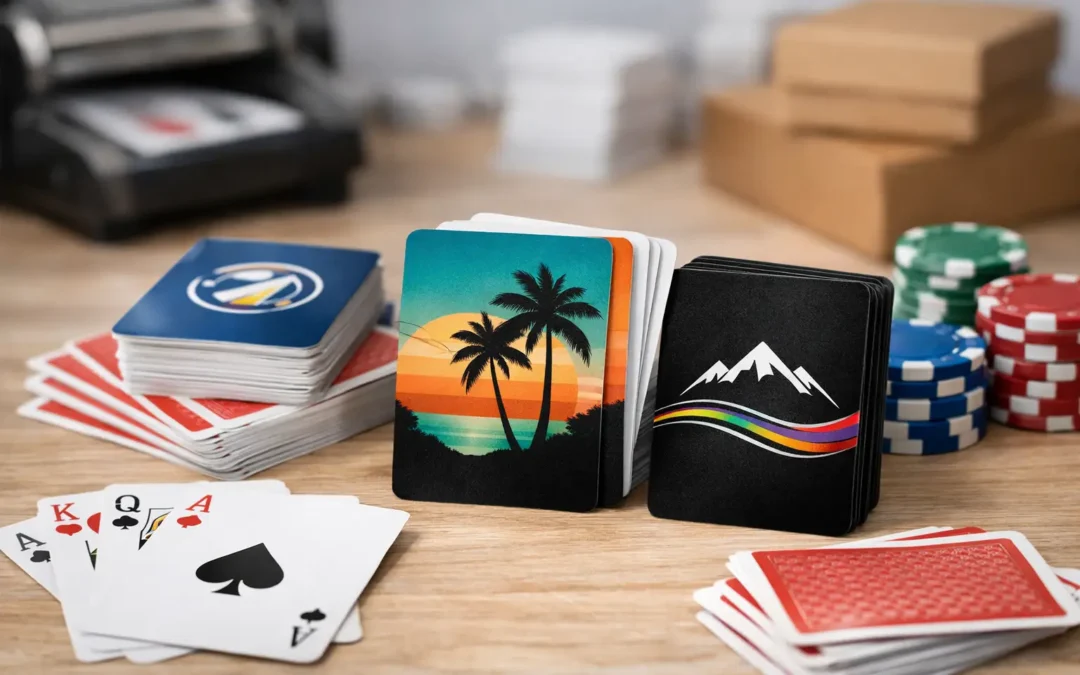
A deck of cards does more work than most promo products get credit for. In the right setting, it stays on tables, travels in bags, gets reused in staff rooms, hotel lounges, club bars and event packs, and keeps your branding in front of people long after the campaign finishes. For business buyers looking at custom playing cards Australia-wide, that matters. You are not buying a novelty item. You are buying something practical, brandable and easy to distribute at scale.
For venues, breweries, clubs, tourism operators and event organisers, custom playing cards can sit comfortably alongside branded drinkware, coasters, stubby holders and other merchandise. They are compact, relatively easy to freight in volume, and they offer a good printable area without demanding a large unit spend. The key is getting the product spec right for how the cards will actually be used.
Why custom playing cards work for commercial use
Playing cards are one of those rare branded products that people already know how to use. There is no explanation needed, no setup, and no learning curve. That makes them a practical option for promotional campaigns, hospitality settings and retail merchandise programs where usability affects retention.
They also suit a wide range of brand environments. A hotel might use them in guest welcome packs or gift shops. A brewery may include them in merchandise bundles or taproom promotions. Clubs and pubs can use them as branded tabletop items or event giveaways. Corporate teams often add them to conference packs or seasonal gift programs. The product is flexible enough to move between promotional use and resale use, depending on the artwork, finish and packaging.
That said, not every deck is right for every application. A low-cost deck may be fine for a short-run campaign handout, but it may not hold up in a hospitality venue where cards are handled regularly. On the other hand, a premium finish can improve presentation, but it needs to justify the higher unit cost if you are ordering in bulk for a wide distribution campaign. As with most promotional merchandise, the best result comes from matching the product to the job.
Choosing custom playing cards Australian businesses can actually use
The first decision is not the artwork. It is the intended use. Business buyers generally fall into a few broad categories: promotional giveaways, resale merchandise, venue use, and event collateral. Each one changes what matters most.
If the cards are being handed out at exhibitions, festivals or trade activations, unit price and presentation usually lead the conversation. The deck needs to look sharp, carry the brand clearly and arrive on time. It does not necessarily need casino-grade stock, but it does need enough quality to avoid feeling disposable.
If the decks are for clubs, pubs, hotel rooms or gaming-adjacent settings, durability becomes more important. Cards that shuffle poorly, mark easily or wear too fast will not reflect well on the venue. In these cases, stock quality, coating and carton strength deserve more attention than simply chasing the lowest price.
For retail or merchandise packs, packaging matters almost as much as the cards themselves. A well-finished tuck box with consistent branding can lift perceived value quickly. Buyers in this category are usually looking for something that feels polished enough to sit beside other branded stock without looking like an afterthought.
Artwork, branding and what buyers often miss
The most effective custom card jobs are usually the simplest. Clear branding, strong contrast and well-prepared artwork tend to outperform overcomplicated layouts. A card back with a clean logo treatment and a tuck box that carries the main visual identity often creates a better result than trying to fill every surface with messaging.
There is also a practical side to artwork approval. Fine details, low-resolution files and colour choices that look good on screen do not always reproduce well in print, especially on smaller packaging panels. Procurement teams and marketing managers can save time by supplying production-ready files early and confirming what must stay fixed across the deck, the box and any outer packaging.
This is where an experienced supplier makes a difference. It is not only about printing the job. It is about checking whether the branding method suits the product, whether the artwork is fit for production, and whether the finish aligns with the intended use. Those details are easy to overlook when a deadline is close.
Bulk ordering means balancing price, lead time and finish
With custom playing cards ordered Australia-wide, bulk volume can improve unit pricing, but it also affects production planning. Larger runs often make better commercial sense, particularly for national promotions, multi-venue groups or repeat event programs. Still, volume alone should not drive the decision.
Sometimes a slightly smaller order with a faster turnaround is the better commercial choice, especially if the cards support a dated activation or seasonal campaign. If stock arrives late, the lowest unit cost stops being a win. Buyers need to weigh production time, freight timing and event deadlines together, not as separate decisions.
Finish is another area where trade-offs matter. Standard decks can be very effective for giveaways and campaign support. Premium stocks and coatings can improve handling and durability, but they add cost and may extend lead times depending on the specification. The right choice depends on whether the cards are meant to be used once, reused regularly, or sold as branded merchandise.
Where custom playing cards fit in a wider merchandise program
For many organisations, playing cards are strongest when they are not treated as a standalone item. They work well as part of a broader merchandise mix, particularly when a campaign needs both practical use and brand consistency.
A brewery launching a new release might pair branded cards with custom glassware and bar accessories. A club may include them alongside drinkware and venue promo items for member packs. Event organisers can add them to sponsor kits, VIP bags or accommodation packs. In each case, the cards support the broader presentation of the brand rather than carrying the full promotional load on their own.
That is often where wholesale supply becomes more valuable. Managing multiple branded products through one supplier can make artwork handling, production timing and fulfilment much easier. For businesses that order in volume, reducing friction in procurement is often just as important as reducing the unit price.
What to ask before placing a custom playing cards order in Australia
Before approving any deck, buyers should be clear on a few operational points. What stock and finish are being quoted? Is the branding on the card backs only, or also on the tuck box? What is the expected production timeline from artwork approval? How will the goods be packed for freight and storage? And if the order is part of a larger campaign, how does that timing line up with other branded items?
These questions are not about complicating the job. They are about avoiding preventable issues. A deck that looks good in a mock-up can still disappoint if the stock feels thin, if the packaging crushes in transit, or if the lead time was optimistic from the start.
It also helps to think beyond the first order. If the product may become part of an ongoing merchandise line or recurring event program, consistency matters. Reorder capability, artwork retention and production reliability all become more valuable over time. That is why many trade buyers prefer working with suppliers who understand repeat-volume supply rather than one-off novelty printing.
A practical option for venues, events and branded promotions
Custom playing cards remain a strong choice because they are easy to brand, easy to distribute and useful across multiple industries. They are not the flashiest item in a campaign, but they are often one of the more dependable. When specified properly, they offer a solid mix of presentation, usability and value.
For Australian businesses buying in volume, the real decision is not whether cards can carry a logo. It is whether the product, finish and production plan are aligned with how the decks will be used. That is the difference between a branded extra and a product that genuinely supports your venue, campaign or merchandise range.
If you are sourcing custom playing cards for a business application, the smartest starting point is to treat them like any other commercial print job – with clear artwork, realistic timelines and a supplier who understands bulk branded product from a production point of view. Done properly, they are simple, effective and easy to put to work.