
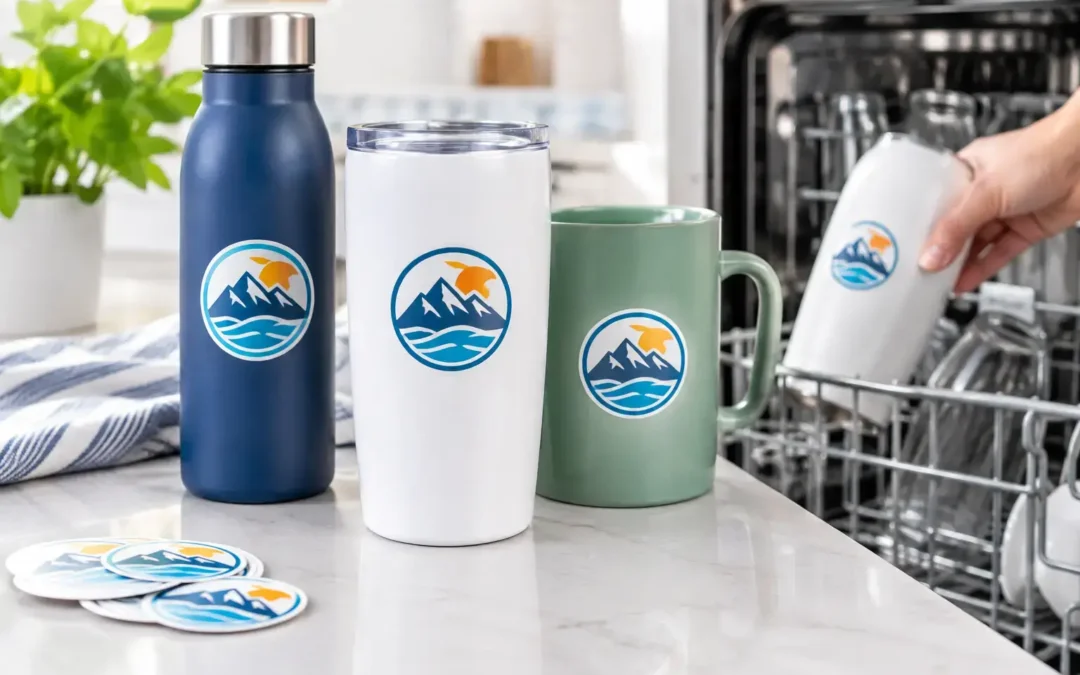
A branded water bottle, reusable coffee cup or bar glass can be used hundreds of times. That makes dishwasher safe stickers a practical branding option only when the material, adhesive and finish suit the item and its washing conditions. For hospitality venues, clubs, breweries and event operators, a label that lifts at the edge or loses colour after a few washes quickly undermines an otherwise professional presentation.
The right specification protects more than the artwork. It helps maintain stock identification, reinforces venue branding and keeps reusable drinkware looking consistent across service. The key is to assess the full application, rather than treating dishwasher safe as a one-size-fits-all claim.
What makes a sticker dishwasher safe?
A dishwasher-safe sticker is designed to resist heat, water pressure, detergent, moisture and handling through repeated wash cycles. In practice, performance depends on several parts working together: the face material, the print method, the protective finish, the adhesive and the surface it is applied to.
Vinyl is commonly selected for durable custom stickers because it is flexible, water-resistant and well suited to curved drinkware. Paper labels may suit short-term packaging or dry indoor use, but they are generally not the right choice for items that will be regularly washed. A clear or white vinyl construction, matched with a durable print and protective laminate, provides a far better starting point for reusable bottles, tumblers and jars.
The adhesive matters just as much. Smooth glass, powder-coated metal, stainless steel and some plastics each behave differently. An adhesive that bonds well to clean glass may not achieve the same hold on a textured powder-coated bottle. The shape of the item also matters. A flat label area gives the best result, while sharp curves, mould seams and narrow bottle necks can put constant stress on sticker edges.
Dishwasher conditions vary widely as well. A domestic cycle is usually less demanding than a commercial glasswasher operating at higher temperatures with stronger chemicals and frequent cycles. If drinkware will be used behind a busy bar or in a café, it is sensible to specify commercial use from the start and test the decoration on the actual product.
Choose the right construction for the job
There is no single material that is best for every branded drinkware project. The intended use, expected lifespan, wash environment and quantity required should guide the decision.
Vinyl with a protective laminate
For many applications, printed vinyl with a clear laminate offers a strong balance of colour reproduction, flexibility and wash resistance. The laminate helps protect the ink from abrasion, detergents and daily handling, while also reducing the risk of scuffing. Gloss finishes can make colours appear brighter, while matt finishes offer a more restrained, premium look and can reduce visible fingerprints.
This option works particularly well for promotional bottles, reusable cups, takeaway drinkware and event merchandise where detailed logos, full-colour artwork or individual designs are required. It is also useful when a campaign needs short-to-medium-term branding without committing to a permanent decoration method.
Clear stickers for glass and jars
Clear dishwasher safe stickers can create a cleaner, less obstructive result on glassware and clear containers. They allow the product to remain visible while placing the focus on the printed logo, message or product identifier. This is often suitable for breweries, cellar doors, cocktail bars and hospitality businesses that want a refined branded finish.
Artwork needs careful preparation for clear stock. White ink may be needed beneath coloured elements to stop the design appearing transparent or washed out against the contents of the glass. Fine text also needs enough weight and contrast to remain legible once applied.
When printing or etching is the better option
A sticker is not always the most durable answer. For glassware that will be commercially washed day after day, screen printing, pad printing or laser etching may offer better long-term performance, depending on the item. Laser etching is especially effective on suitable coated metal drinkware, producing a permanent mark without an added label layer.
The trade-off is flexibility. Stickers can be cost-effective for variable artwork, shorter runs, product labelling or campaigns that change regularly. Direct printing and etching can be more suitable for repeat venue stock, larger standardised orders and branding intended to last for the product’s full life.
Dishwasher safe stickers for hospitality and events
Hospitality buyers often need a solution that is practical beyond the initial presentation. Branded stickers can help identify venue-owned reusable cups, distinguish barware for functions, add sponsor branding to event drinkware or support product labelling in back-of-house areas.
For these uses, avoid specifying only the logo size and colour. Consider where the sticker will sit during service. A label placed where hands regularly grip the cup will receive more abrasion than one placed on an upper or lower clear panel. On bottles, allow space around seams, contours and bases so the edges can achieve full contact with the surface.
Event timing should also shape the decision. If drinkware is being supplied for a one-off festival or campaign, a high-quality laminated sticker may be the right commercial choice. For a club, brewery or venue replacing branded glassware throughout the year, permanent decoration may deliver better value over time. The right answer depends on the expected number of washes, not simply the upfront unit price.
Artwork and application details that affect results
Good sticker performance begins before production. Supply clean, high-resolution artwork and keep small text, fine lines and intricate details realistic for the final sticker size. A logo that looks sharp on a screen can lose impact when reduced to a small curved application area.
Colour matching should be discussed early, particularly where the sticker needs to align with existing printed menus, uniforms, signage or other branded merchandise. Digital print is well suited to full-colour artwork and gradients, while spot-colour requirements may call for a different production approach. If brand consistency is critical, approve an artwork proof before the full run proceeds.
Application is equally important. The drinkware surface should be clean, dry and free from oil, dust and residue. Staff should avoid touching the adhesive where possible, apply the sticker with even pressure and work from one edge to the other to minimise bubbles. After application, allow adequate curing time before washing. Rushing newly labelled stock into service can reduce the bond before the adhesive has fully settled.
Planning a bulk order with fewer surprises
For bulk branded drinkware, the most efficient process is to define the product, decoration method and operating environment together. Provide the intended quantity, artwork, target delivery date and details about how the item will be washed. This gives the supplier the information needed to recommend a suitable stock, adhesive and finish rather than relying on a generic label specification.
It is also worthwhile to request a sample or conduct a wash test for demanding applications. Test the finished sticker on the chosen drinkware, using the same dishwasher, detergent and cycle likely to be used in operation. Check for edge lift, fading, scratches and reduced adhesion after repeated washes. A small test can prevent a costly issue across hundreds or thousands of units.
For projects involving multiple locations, consider how stock will be packed and distributed. Separating products by venue, campaign or artwork variation can simplify receiving and reduce relabelling work on site. Clear carton identification and realistic production lead times are especially valuable when stock is required for a launch, opening or major event date.
ABC2000 can assist business buyers with branded drinkware, custom decoration and bulk-order planning, helping match the branding method to the product and the conditions it will face.
The best result is not simply a sticker that survives one wash. It is drinkware that continues to represent the business properly after the rush of service, the next event and the many wash cycles that follow.